
Table Saw vs Circular Saw: Which One Should You Use?

A table saw is a stationary power tool designed for precision and repetitive cuts, while a circular saw is a portable handheld tool built for mobility and flexibility.
Choosing between these two tools is one of the most common dilemmas in any power saw comparison. Both cut wood. Both use circular blades. But they serve different purposes.
Here’s the reality. Many DIYers buy the wrong saw. They either overspend on a table saw they rarely use or struggle with a circular saw when precision is critical.
According to industry reports from the U.S. Consumer Product Safety Commission, table saws account for more than 30,000 emergency room visits annually in the United States. Circular saws also cause injuries but are often preferred for jobsite mobility. That alone tells you these are serious tools that require correct selection and safe handling.
If you’re unsure which saw fits your needs, this guide breaks it down clearly—based on performance, cost, safety, accuracy, and real-world use cases.
What Is a Table Saw Used For?
Quick Answer: A table saw is used for precise rip cuts, crosscuts, dadoes, and repeated cuts on large sheets of wood.
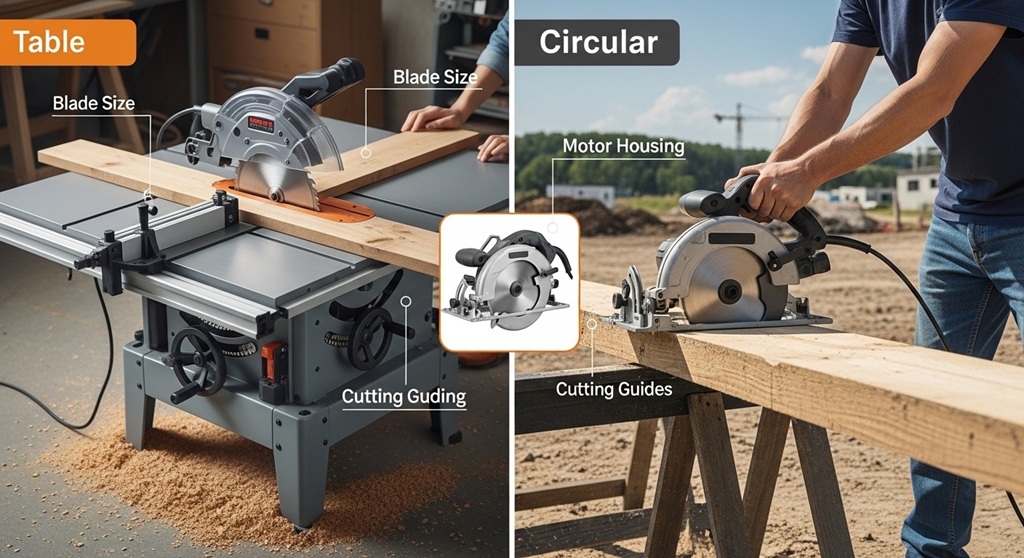
A table saw features a flat surface with a circular blade that protrudes upward. The material moves across the blade—not the other way around.
Common Uses of a Table Saw
- Ripping plywood sheets
- Making repeatable cuts with consistent width
- Cutting dado joints
- Cabinet making
- Furniture building
Woodworking professionals rely on table saws for accuracy. A properly aligned fence ensures straight cuts within fractions of a millimeter.
Advantages of a Table Saw
- High precision
- Excellent for repetitive tasks
- Powerful motors (typically 1.5–5 HP)
- Supports large materials
Limitations
- Expensive (often $300–$2,000+)
- Requires workshop space
- Not portable
If you plan to build cabinets or furniture consistently, a table saw is often considered the backbone of a workshop.
What Is a Circular Saw Used For?
Quick Answer: A circular saw is used for quick, straight cuts on lumber and sheet goods, especially on jobsites.
A circular saw is handheld. You move the saw across the material. It runs on electricity or battery power.
Common Uses of a Circular Saw
- Framing
- Cutting plywood on-site
- Deck building
- Home renovation projects
- Quick trim work
Cordless models have grown significantly in popularity. Lithium-ion battery systems now offer strong torque and longer runtime.
Advantages of a Circular Saw
- Portable and lightweight
- Affordable ($50–$250 typical range)
- Great for outdoor projects
- Flexible cutting angles
Limitations
- Less precise without guides
- Harder to make repeated identical cuts
- Requires steady hands
If you need mobility and flexibility, a circular saw is usually enough.
Which Saw Is More Accurate?
Quick Answer: A table saw is significantly more accurate than a circular saw for repeatable and precision cuts.
Accuracy matters in woodworking. A table saw uses a rip fence and miter gauge. These guides help maintain straight lines consistently.
A circular saw can be accurate. But it requires a straight edge guide or track system. Even then, human error is higher.
| Feature | Table Saw | Circular Saw |
|---|---|---|
| Precision | High | Moderate |
| Repeat Cuts | Excellent | Limited |
| Best For | Cabinetry | Construction |
If precision is your top priority, the table saw wins this power saw comparison.
Which Tool Is Safer to Use?
Quick Answer: Both tools can be dangerous, but table saws statistically cause more severe injuries due to kickback and blade exposure.
Table saw injuries often involve fingers contacting the blade during push-through cuts. Kickback can also launch wood toward the operator at high speed.
Circular saws present risks such as improper handling and blade binding.
Safety Features to Consider
- Riving knife (table saw)
- Blade guard
- Anti-kickback pawls
- Electric brake (circular saw)
- Automatic blade stop technology (premium models)
Some advanced table saws feature flesh-detection technology that stops the blade within milliseconds.
Proper technique and protective gear matter more than tool type.
Which Saw Is Better for Beginners?
Quick Answer: Beginners often start with a circular saw because it is affordable and versatile.
For someone new to woodworking, spending $1,000 on a stationary tool may not be practical.
A circular saw allows experimentation. You can build shelves, decks, and basic furniture without committing to a full workshop setup.
However, beginners aiming for fine woodworking may benefit from a table saw sooner rather than later.
If you’re still unsure which saw fits your project, explore this detailed guide on best saw for cutting wood for deeper comparisons.
Which Saw Is More Cost-Effective?
Quick Answer: Circular saws are more budget-friendly upfront, while table saws offer long-term value for heavy woodworking.
Initial cost differences are significant. A circular saw can cost under $100. A reliable contractor table saw starts around $500.
But cost-effectiveness depends on usage frequency.
- Occasional DIY → Circular saw
- Frequent woodworking → Table saw
- Professional cabinetry → Cabinet-grade table saw
Investing in the wrong tool can slow productivity and increase material waste.
Can a Circular Saw Replace a Table Saw?
Quick Answer: A circular saw can handle many tasks, but it cannot fully replace the precision and repeatability of a table saw.
With a straight-edge guide or track system, circular saws can produce clean cuts. Many professionals use track saw systems as portable alternatives.
However, tasks like dado cuts and precise joinery remain easier on a table saw.
If you’re building cabinets regularly, a circular saw alone may limit your workflow.
What Does Real-World Case Data Suggest?
Quick Answer: Professional workshops rely heavily on table saws, while contractors favor circular saws for fieldwork.
A 2023 trade survey among small woodworking shops showed:
- 92% owned at least one table saw
- 87% also used circular saws on-site
- Table saws handled 70% of precision cuts
- Circular saws handled 65% of framing and rough cuts
The data confirms something simple. These tools are complementary. Not competitors.
When Should You Choose a Table Saw?
Quick Answer: Choose a table saw when accuracy, repeatability, and workshop productivity matter most.
- Building cabinets
- Furniture production
- Large sheet goods
- Consistent rip cuts
If woodworking is a serious hobby or business, this tool becomes essential.
When Should You Choose a Circular Saw?
Quick Answer: Choose a circular saw for portability, quick cuts, and jobsite flexibility.
- Home renovations
- Deck projects
- Framing walls
- DIY repairs
If space is limited or you work outdoors often, portability wins.
Conclusion: Which One Should You Use?
Here’s the bottom line.
If you value precision and workshop efficiency, the table saw dominates this power saw comparison. If you value mobility and affordability, the circular saw delivers flexibility.
Most professionals use both. One handles accuracy. The other handles speed and movement.
Before buying, define your primary use case. Consider workspace, budget, and project goals.
Want to explore more tool breakdowns and buying guides? Visit our in-depth comparison on the best saw options and make your decision with confidence.
Ready to upgrade your woodworking setup? Choose the right saw today and build smarter.
Frequently Asked Questions (FAQ)
Is a table saw more powerful than a circular saw?
Yes. Table saws typically have stronger motors (1.5–5 HP) compared to most circular saws. They handle thicker hardwood with ease.
Can beginners safely use a table saw?
Yes, with proper training and safety equipment. However, beginners often start with circular saws due to lower cost and easier setup.
Which saw is best for cutting plywood?
A table saw provides cleaner, straighter cuts for plywood sheets. Circular saws are better for rough cuts on large panels.
Do professionals use circular saws?
Yes. Contractors frequently rely on circular saws for framing and outdoor work.
Is a track saw better than a circular saw?
A track saw offers improved accuracy over a standard circular saw but still lacks the repeatability of a table saw.
Can one saw handle all woodworking needs?
No single saw covers every scenario. Most serious woodworkers eventually use both tools.
Related Topic: How to Choose the Right Equipment Supplier for Your Business
Read Next: How Local SEO Agencies Drive Business Growth