
How Bright Should Aquarium LED Lights Be for Healthy Fish?
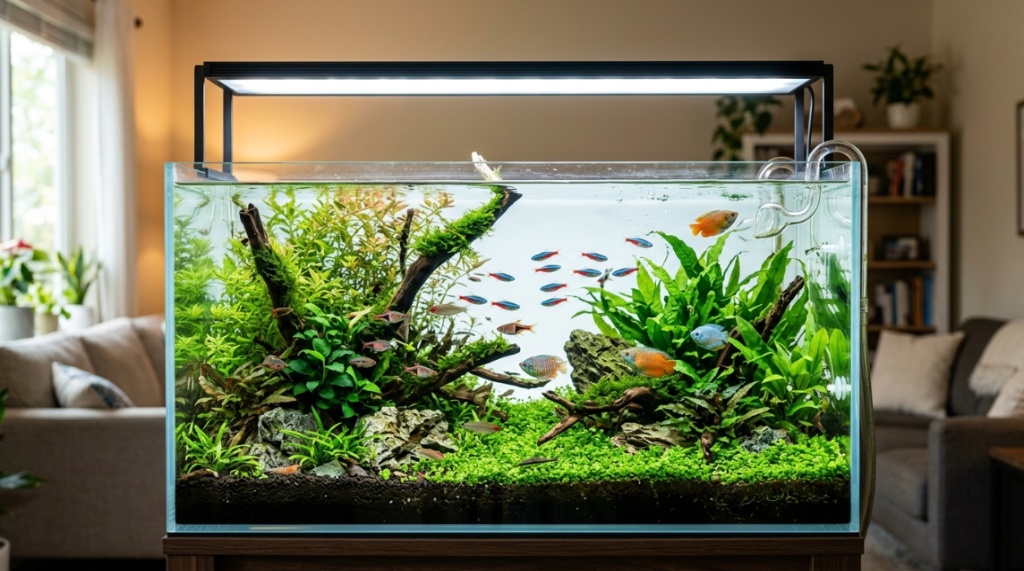
You set up your tank, added the fish, and now you stare at a dim, murky box that looks nothing like the vibrant underwater worlds you see online. Or worse, you bought a blindingly bright light, and your fish are hiding in the corners, stressed and pale. Getting the aquarium light brightness aquarium LED lights right isn’t just about aesthetics—it’s the single most important factor for your fish’s health, plant growth, and algae control. The problem is that most advice is either too vague or contradictory. Let’s fix that with a clear, actionable guide.
What Is the Ideal Brightness in Lumens and PAR for a Home Aquarium?
The ideal brightness depends on your tank type. For a standard fish-only community tank, aim for 10–20 lumens per liter (or 40–80 PAR at the substrate). For a planted tank with demanding plants, you need 30–50 lumens per liter (80–150 PAR). Low-light tanks (e.g., with Anubias or Java Fern) thrive at 10–15 lumens per liter.
Lumens measure total visible light output, but PAR (Photosynthetically Active Radiation) is the gold standard for aquariums because it measures the light actually available for photosynthesis. Most affordable LED lights list lumens, but PAR charts are more accurate. A 60 cm tank with 20–25 PAR at the bottom is perfect for most beginner fish and hardy plants.
Here’s a quick reference table:
| Tank Type | Lumens per Liter | PAR at Substrate | Example Plants |
|---|---|---|---|
| Fish-only / Low-light | 10–20 | 15–40 | Java Fern, Anubias, Hornwort |
| Moderately Planted | 20–35 | 40–70 | Cryptocoryne, Vallisneria, Swords |
| High-tech Planted | 35–50 | 80–150 | Dwarf Hairgrass, Monte Carlo, Rotala |
Actionable takeaway: If you have a 100-liter standard tank, a 1200–2000 lumen light is usually safe. For PAR, look for lights with published data or use a PAR meter.
Why Does Light Brightness Matter for Fish Health and Behavior?
Brightness directly controls fish stress levels, circadian rhythms, and even immune function. Fish rely on photoperiods (day/night cycles) to regulate sleep, feeding, and breeding. Too-bright lights cause chronic stress, suppressed appetite, and fin nipping. Too-dim lights can lead to lethargy and a suppressed immune system.
Fish like tetras and rasboras come from dimly lit, tea-colored rivers. A 10,000K super-bright light blasting a blackwater biotope is stressful. Cichlids from open African lakes, however, are native to intense equatorial sunlight. Matching brightness to the fish’s natural habitat is key.
Signs Your Light Is Too Bright
- Fish hide constantly, even during daytime
- Fish remain pale or washing out colors
- Rapid gill movement (stress)
- Excessive algae blooms (especially green water or hair algae)
Signs Your Light Is Too Dim
- Plants turn yellow, melt, or grow long, thin stems (etiolation)
- Fish become lethargic and inactive
- The tank looks dingy and uninviting
Pro tip: Always use a gradual ramp-up and ramp-down timer. A sharp on/off transition mimics a predator event and spikes cortisol in fish.
How Do I Calculate the Right LED Brightness for My Tank Size and Depth?
Use the “wattage per gallon” rule only as a rough starting point—LEDs are far more efficient than old T8 fluorescents. A better method: Depth x Target PAR / LED efficiency.
- Measure tank depth (from water surface to substrate).
- Decide your target PAR (e.g., 30 PAR for low-light plants).
- Check LED specs for PAR at that depth. Many brands provide a graph.
- Adjust with height: Raising the light reduces intensity; lowering increases it.
For example, a 60 cm deep tank with carpet plants needs roughly 120–150 PAR at the bottom. That typically requires two powerful LED strips or a single high-output panel. Conversely, a shallow 25 cm nano tank needs only 10–15 watts of LED.
Quick math: Most modern LED lights produce about 80–100 lumens per watt. So a 30-watt LED gives ~2700 lumens—plenty for a 100-liter standard tank with moderate plants.
Which LED Light Spectrum Is Best for Aquarium Fish and Plants?
Full-spectrum LEDs (6500K–7000K) are the best all-around choice. They mimic natural daylight, promote healthy plant growth, and make fish colors pop. Blue-heavy spectrums (10,000K+) can cause algae and wash out warm colors. Red-heavy spectrums (3000K–5000K) look warm but may not penetrate deep water well.
For planted tanks, a balance of red (660nm) and blue (450nm) wavelengths is critical. Red light drives chlorophyll production and photosynthesis, while blue light controls leaf growth and prevents stretching. White LEDs with high CRI (>90) give a natural look and excellent color rendering.
Avoid: Cheap “blue bar” lights or disco-colored RGB lights. They stress fish and don’t support healthy plant growth. Stick with daylight white (6500K) or “planted tank” spectrum lights.
While setting up the perfect lighting intensity is crucial for your livestock’s well-being, maintaining pristine water chemistry is equally vital. If you are managing a delicate marine environment, make sure to learn how to choose the best reef aquarium test kit for home use to ensure your water parameters stay perfectly balanced alongside your light settings.
Can Too Much Light Cause Algae Problems?
Yes, absolutely. Excess light is the number one cause of nuisance algae (green water, hair algae, and cyanobacteria). When light energy exceeds what your plants can absorb, algae take advantage of the surplus. The general rule: If you see green hair algae, lower your light intensity or duration.
Algae blooms are often triggered by:
- Running lights longer than 8–10 hours a day
- High-intensity light with no CO2 injection
- New tanks (first 4–6 weeks are algae-prone)
- High nutrient levels combined with intense light
The fix isn’t always to dim the light. Sometimes it’s about balance: reducing photoperiod to 6–7 hours, adding fast-growing plants (like Hornwort or Water Wisteria), or injecting CO2. But if your PAR readings are above 100 in a low-tech tank, algae will likely win.
Algae threshold: Low-tech tanks (no CO2) should stay under 40–50 PAR at the substrate. High-tech tanks can handle 80–150 PAR if CO2 and fertilizers are balanced.
How Long Should Aquarium LED Lights Be On Each Day?
Set a photoperiod of 8 to 10 hours for most community tanks. Planted tanks with high light can run 7–8 hours. Use a timer and include a 30-minute ramp-up and ramp-down to simulate dawn and dusk.
Consistency is critical. Fish and plants have circadian rhythms that depend on predictable light cycles. Irregular on/off times stress fish and confuse plant metabolism. Never run lights more than 12 hours—this drastically increases algae risk without benefiting fish or plants.
Sample schedule:
- 7:00 AM – Ramp-up begins (20% brightness)
- 8:00 AM – Full brightness (8 hours)
- 4:00 PM – Ramp-down begins
- 5:00 PM – Lights off
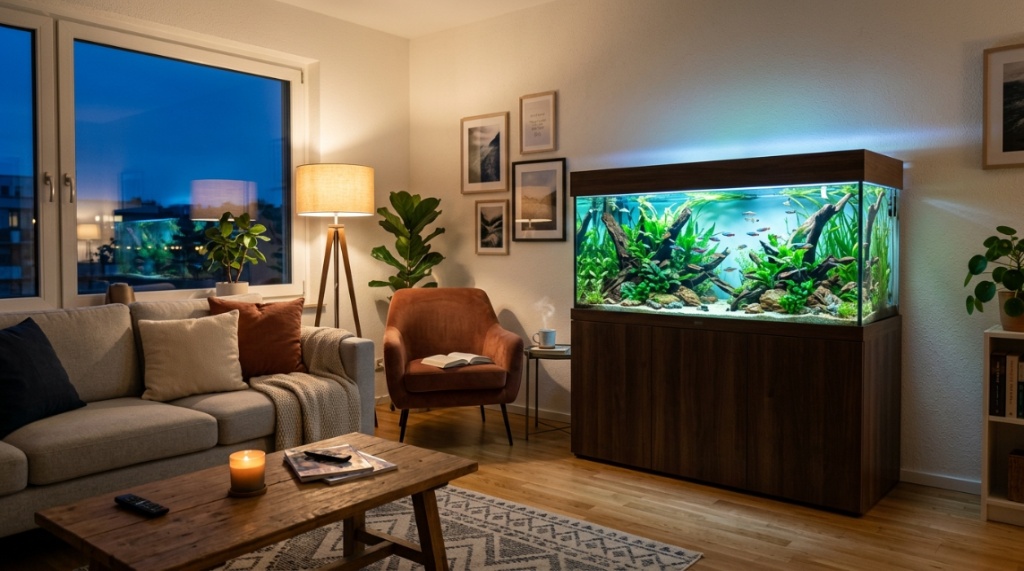
- Moonlight (if available): dim blue at 1–5% intensity for nighttime viewing
How Do I Adjust Brightness for New Aquariums and Fish?
Start at 50–60% intensity for the first two weeks in a new tank. Gradually increase by 10% every week as plants establish roots and algae becomes manageable. For fish, always use a dimmer or distance adjustment to avoid sudden brightness shocks.
Freshly introduced fish are already stressed from transport. A bright light immediately after adding them can cause acute stress and even death. Keep lights off for the first 4–6 hours after adding new fish, then slowly ramp up over 2–3 days. This is especially important for shy species like Corydoras, Apistogramma, and neon tetras.
Acclimation period: 2 weeks at low light, then 2 weeks at medium, then full brightness—if your tank is heavily planted. For fish-only tanks, full brightness isn’t necessary at all.
What Are the Best Affordable Aquarium LED Lights for Correct Brightness?
Look for lights with adjustable brightness, timers, and published PAR data. Brands like Nicrew, Hygger, and Aquaneat offer excellent budget options with dimmable features. For planted tanks, the Finnex Planted+ or Fluval Plant 3.0 provide fine-tuned control.
When choosing, pay attention to wattage per length. A 24-inch tank typically needs a 30–50 watt light. A 48-inch tank needs 50–80 watts. Adjustability is worth paying extra for—rigidly fixed-brightness lights are inflexible.
For a deeper dive into specific models, check out this resource on aquarium light brightness aquarium LED lights. It breaks down the best options for different budgets and tank sizes.
Is It Better to Have a Single Strong Light or Multiple Weak Ones?
Multiple lights are almost always better than one overpowered unit for depth penetration and even coverage. A single bright light creates hot spots and shadows. Two or three medium-strength lights spaced evenly provide uniform brightness and reduce “dark corners.”
For a 120 cm tank, two 60 cm lights are more effective than one 120 cm light because they reduce intensity drop-off at the edges. For deep tanks (60 cm+), you may need a high-output panel placed closer to the water—but only if you run CO2.
Rule of thumb: One 30-watt light per 60 cm of tank length for standard depth (40–50 cm). For deeper tanks, add 10–15 watts per additional 10 cm of depth.
How Do I Measure Actual Brightness at Home Without a PAR Meter?
Use a smartphone app like Lux Light Meter Pro (iOS/Android) as a rough guide. It’s not as accurate as a PAR meter, but it gives you a relative baseline. Place your phone at the water surface, then at the substrate, and note the difference.
Lux readings convert loosely to PAR: 1 lux ≈ 0.02 PAR for full-spectrum LEDs. So 20,000 lux at the surface equals about 400 PAR (too high for most tanks). Aim for 10,000–15,000 lux at the surface for a moderately planted tank, and 3,000–5,000 lux at the bottom.
DIY check: Hold your hand 6 inches above the water. If the light is too bright to look at comfortably for 5 seconds, it’s likely too bright for most fish. A good rule: the light should feel like a bright overcast day, not direct desert sun.
Frequently Asked Questions
Can LED lights be too bright for fish?
Yes. Extremely bright LEDs (100+ PAR) can cause chronic stress, excessive algae, and unnatural behavior. Fish from dim environments (blackwater species) are especially sensitive. Always match brightness to the fish’s natural habitat.
Do aquarium plants need very bright LED lights?
Only high-demand plants (carpets, stem plants) need bright light (80–150 PAR). Low-light plants like Anubias, Java Fern, and Moss thrive at 10–30 PAR. Most beginner plants are low-light tolerant.
How do I dim my aquarium LED lights if they aren’t adjustable?
Raise the light fixture higher above the tank—every 2 inches of height roughly halves the PAR. Or place floating plants (Duckweed, Salvinia) to diffuse light. You can also install a mesh screen as a diffuser.
What is the best color temperature for fish?
6500K (daylight white) is best for most freshwater fish. It mimics natural sunlight, promotes healthy coloration, and supports plant growth. Avoid blue-only lights except for brief nighttime moonlight simulations.
How often should I replace aquarium LED lights?
Quality LEDs last 30,000–50,000 hours. However, PAR drops by about 20–30% after 2–3 years of daily use. Replace or upgrade every 3–4 years for planted tanks. Fish-only tanks can go longer.
Can I use a regular house LED bulb for my aquarium?
No. House bulbs lack the correct spectrum (usually 2700–3000K), emit too little PAR at the bottom, and may have harmful UV components. Use dedicated aquarium LED lights designed for high humidity and proper spectrum.
Should I use a moon light at night?
Only if it’s very dim (<5% intensity). Bright blue lights at night disrupt fish sleep cycles and can cause algae growth. Dim blue moonlight is safe for short periods and allows you to view nocturnal fish.
Conclusion: Finding Your Tank’s Brightness Sweet Spot
Getting the brightness right transforms your aquarium from a stressful glass box into a thriving ecosystem. Start with the lumens and PAR targets outlined here, adjust based on your fish species and plant goals, and always use a timer for consistent photoperiods. Remember that less is often more—most beginners over-light their tanks, leading to algae frustration and fish stress. Trust your fish’s behavior. If they actively swim, eat, and show natural colors, you’re in the sweet spot. If they hide or the tank is overrun with green slime, back off on intensity or duration. Your fish, plants, and water chemistry will thank you. Now dim those lights, grab a timer, and watch your tank come to life.